
2010–2013: BAWAG CONTEMPORARY
Ragnar Kjartansson
Take me here by the Dishwasher – Memorial for a Marriage
6/5/2011—26/6/2011


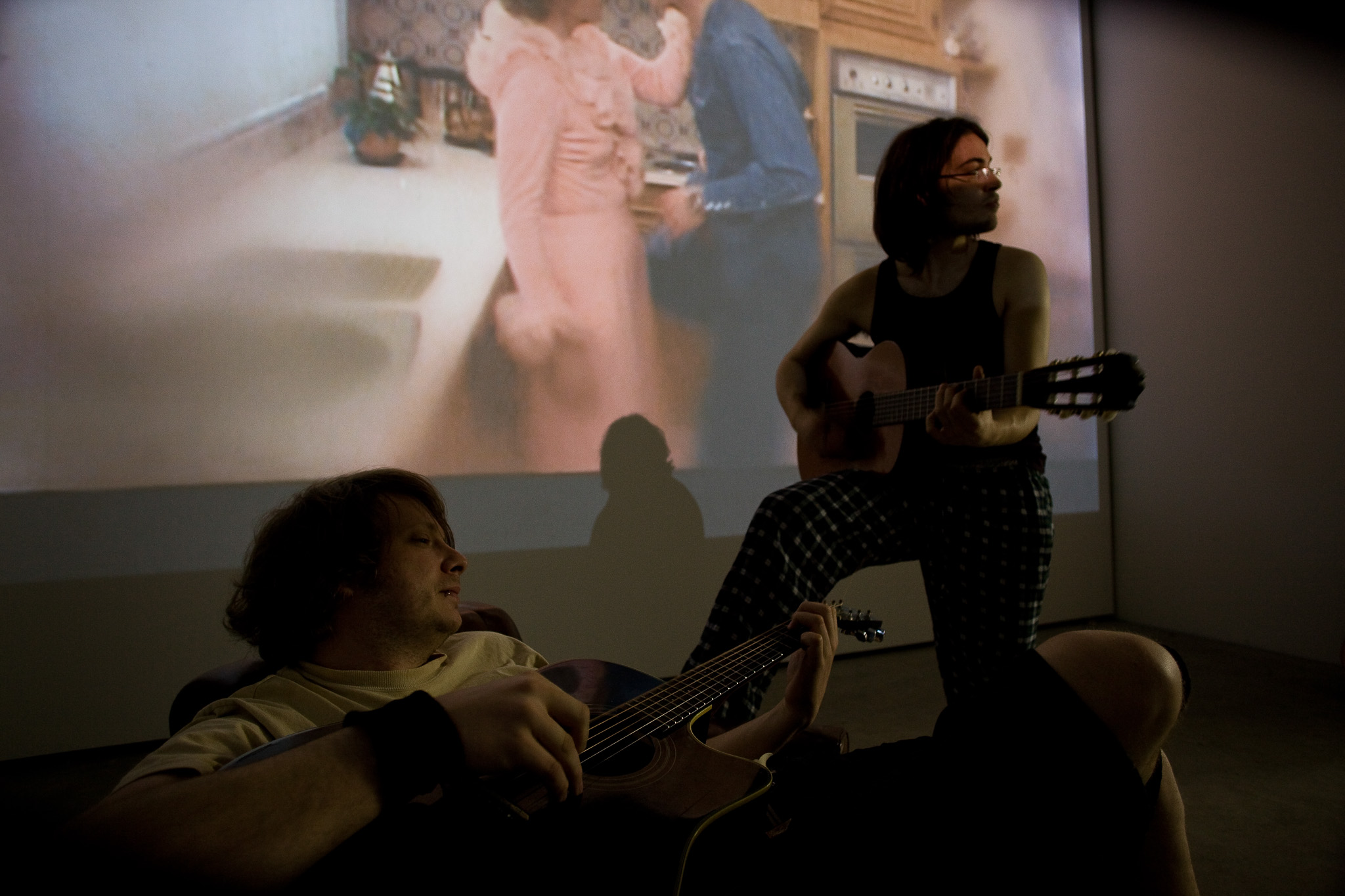


Even if it does not look like it, the exhibition Take me here by the Dishwasher is a portrait. Ragnar Kjartansson, who describes himself as a hopeless romantic, is an Icelandic artist who mainly works in the fields of performance, theater, and music. Yet he is also into more traditional media such as painting, drawing, and video. Cultural history and myth, rituals, and a range of identities, grief, happiness, beauty, horror, drama, humor – such are the ingredients of an oeuvre for whose existence there is only one reason: a charismatic person’s impulse to entertain.
Even the conception of the artist lies in a mist of reality and fiction. Kjartansson, who was born into a family of theater people, insinuates to have been sired on the set of Iceland’s first erotic thriller. Morðsaga (Reynir Oddsson, 1977) featured his mother, Guðrún Ásmundsdóttir, as a lonely housewife, while his father, Kjartan Ragnarsson, played the plumber she calls in her dreams to repair the dishwasher. Ragnar was actually born in the month in which the love scene was shot. Take me here by the Dishwasher shows the decisive moment in a loop.
Ragnar Kjartansson has been interested in the role model of the artist from the very beginnings of his fast-moving career. His works may be seen as ongoing assessments of the status of the artist, his work, and the public. Who am I, where am I, what am I doing here, what has happened before I came here? The questions a method actor has to ask himself according to Lee Strasberg also seem to inform the technique of the exhibitionist artist who produces props for tableaux vivants and role plays that supply parts of his personal identity puzzle – a portrait of the artist as a painter of nocturnal seascapes, an opera singer in a rococo theater, and a lonesome cowboy with guitar in the Rocky Mountains.
Since having witnessed Dieter Roth reading poems or cursing managers at Reykjavík University, Ragnar Kjartansson knows about the importance of presence. This is why his work is always live and definitely performative. For the question how art is born is as important as the result. The exhibition at BAWAG Contemporary also centers around a time-bound work, a work concerned with the moment in which art happens: ten troubadours (the artist has relied on the figure of the romantic hero in various contexts, whether in the form of a legendary troubadour, a fantasy version of Prince Valiant, or the man with the guitar) sing a dialogue fragment from the film Morðsaga in casual clothes; the music comes from Kjartan Sveinsson, the legendary keyboarder of the Icelandic post-rock band Sigur Rós. The troubadours are professional musicians, all of whom play the guitar. The figure of the man with the guitar, a symbol of rebellion in youth culture all over the world, has become almost an icon in popular mythologies.
In the exhibition, this supersymbol strikes up a slightly exhausted alliance with beer and cigarettes. The performers meet on each day of the exhibition, smoke, drink, and sing their song. Thus, a social sculpture will emerge as a wrecked version of the perpetual return of the same; one may make out a little Nietzsche syndrome in the end. Beyond that, Kjartansson devotes himself to gender stereotypes with apparent pleasure and repeatedly explains that his art springs from feminism. The pathos that the image of the man with the guitar radiates is as welcome as the artist’s sexualization through the instrument.
Kjartansson’s method is one of unfolding an infinite number of stories, cycles, and absurd loops. He juxtaposes elements relevant for art with a body of nostalgic cultural references in his pasticcios, letting all distinctions seep away in an Icelandic mudpot.
Kjartansson’s performances often go on for many hours or even days and require the artist’s complete physical commitment. At the Manifesta 8 in Rovereto, for example, Kjartansson sang Schumann’s Dichterliebe (The Poet’s Love) accompanied by a piano eight hours a day for two weeks. The decadent version of the lieder recital had him donning an elegant black tuxedo with a bow tie, smoking thick cigars, and drinking champagne until he could not stand up anymore. [...]
Kjartansson’s serious and brilliant snapshots deal with love and friendship, beauty and broken hearts, love and death, happiness and pain, heaven and hell – never with victo- ries, often with defeats. The name of his model is eternity.
In the gallery’s backspace in the basement, Ragnar Kjartansson will present a very per- sonal portrait of the Mississippi blues musician Pinetop Perkins (b. in Belzoni, Mississippi on July 7, 1913; d. in Austin, Texas on March 21, 2011), whom he reveres. “Eternal Pinetop” steps into the film, shot from one fixed position, like onto a stage. He wears elegant beige trousers, a white shirt, and his inevitable hat. Set on the outskirts of Austin, Texas, Pinetop’s place of residence, Ragnar Kjartansson’s film relates to Andrew Wyeth’s famous picture Christina’s World: we see a treeless, flat slope with a house looming on the horizon, but Wyeth’s girl suffering from polio who creeps toward the house has been replaced by the 97-year-old Pinetop Perkins at the piano given to him as a present by eighty friends for his eightieth birthday. He begins to play the blues, repeats a passage played, mumbles something, and, looping through his melodies and rhythms, slips in some jingle or other. He smokes all the time, complains about the badly tuned piano, and, after forty-nine minutes, exits as laconically as he has come on stage. Though the touch of the legendary oldest Grammy winner under the sun may be a bit blurry, his fan’s and kindred spirit’s video The Man (2010) preserves the ninety-seven- year-old Perkins’s brilliant musicality.
Curator: Brigitte Huck
Press: Christina Werner
Even the conception of the artist lies in a mist of reality and fiction. Kjartansson, who was born into a family of theater people, insinuates to have been sired on the set of Iceland’s first erotic thriller. Morðsaga (Reynir Oddsson, 1977) featured his mother, Guðrún Ásmundsdóttir, as a lonely housewife, while his father, Kjartan Ragnarsson, played the plumber she calls in her dreams to repair the dishwasher. Ragnar was actually born in the month in which the love scene was shot. Take me here by the Dishwasher shows the decisive moment in a loop.
Ragnar Kjartansson has been interested in the role model of the artist from the very beginnings of his fast-moving career. His works may be seen as ongoing assessments of the status of the artist, his work, and the public. Who am I, where am I, what am I doing here, what has happened before I came here? The questions a method actor has to ask himself according to Lee Strasberg also seem to inform the technique of the exhibitionist artist who produces props for tableaux vivants and role plays that supply parts of his personal identity puzzle – a portrait of the artist as a painter of nocturnal seascapes, an opera singer in a rococo theater, and a lonesome cowboy with guitar in the Rocky Mountains.
Since having witnessed Dieter Roth reading poems or cursing managers at Reykjavík University, Ragnar Kjartansson knows about the importance of presence. This is why his work is always live and definitely performative. For the question how art is born is as important as the result. The exhibition at BAWAG Contemporary also centers around a time-bound work, a work concerned with the moment in which art happens: ten troubadours (the artist has relied on the figure of the romantic hero in various contexts, whether in the form of a legendary troubadour, a fantasy version of Prince Valiant, or the man with the guitar) sing a dialogue fragment from the film Morðsaga in casual clothes; the music comes from Kjartan Sveinsson, the legendary keyboarder of the Icelandic post-rock band Sigur Rós. The troubadours are professional musicians, all of whom play the guitar. The figure of the man with the guitar, a symbol of rebellion in youth culture all over the world, has become almost an icon in popular mythologies.
In the exhibition, this supersymbol strikes up a slightly exhausted alliance with beer and cigarettes. The performers meet on each day of the exhibition, smoke, drink, and sing their song. Thus, a social sculpture will emerge as a wrecked version of the perpetual return of the same; one may make out a little Nietzsche syndrome in the end. Beyond that, Kjartansson devotes himself to gender stereotypes with apparent pleasure and repeatedly explains that his art springs from feminism. The pathos that the image of the man with the guitar radiates is as welcome as the artist’s sexualization through the instrument.
Kjartansson’s method is one of unfolding an infinite number of stories, cycles, and absurd loops. He juxtaposes elements relevant for art with a body of nostalgic cultural references in his pasticcios, letting all distinctions seep away in an Icelandic mudpot.
Kjartansson’s performances often go on for many hours or even days and require the artist’s complete physical commitment. At the Manifesta 8 in Rovereto, for example, Kjartansson sang Schumann’s Dichterliebe (The Poet’s Love) accompanied by a piano eight hours a day for two weeks. The decadent version of the lieder recital had him donning an elegant black tuxedo with a bow tie, smoking thick cigars, and drinking champagne until he could not stand up anymore. [...]
Kjartansson’s serious and brilliant snapshots deal with love and friendship, beauty and broken hearts, love and death, happiness and pain, heaven and hell – never with victo- ries, often with defeats. The name of his model is eternity.
In the gallery’s backspace in the basement, Ragnar Kjartansson will present a very per- sonal portrait of the Mississippi blues musician Pinetop Perkins (b. in Belzoni, Mississippi on July 7, 1913; d. in Austin, Texas on March 21, 2011), whom he reveres. “Eternal Pinetop” steps into the film, shot from one fixed position, like onto a stage. He wears elegant beige trousers, a white shirt, and his inevitable hat. Set on the outskirts of Austin, Texas, Pinetop’s place of residence, Ragnar Kjartansson’s film relates to Andrew Wyeth’s famous picture Christina’s World: we see a treeless, flat slope with a house looming on the horizon, but Wyeth’s girl suffering from polio who creeps toward the house has been replaced by the 97-year-old Pinetop Perkins at the piano given to him as a present by eighty friends for his eightieth birthday. He begins to play the blues, repeats a passage played, mumbles something, and, looping through his melodies and rhythms, slips in some jingle or other. He smokes all the time, complains about the badly tuned piano, and, after forty-nine minutes, exits as laconically as he has come on stage. Though the touch of the legendary oldest Grammy winner under the sun may be a bit blurry, his fan’s and kindred spirit’s video The Man (2010) preserves the ninety-seven- year-old Perkins’s brilliant musicality.
Curator: Brigitte Huck
Press: Christina Werner